3 minutes
The Ghost in the Untethered Wire
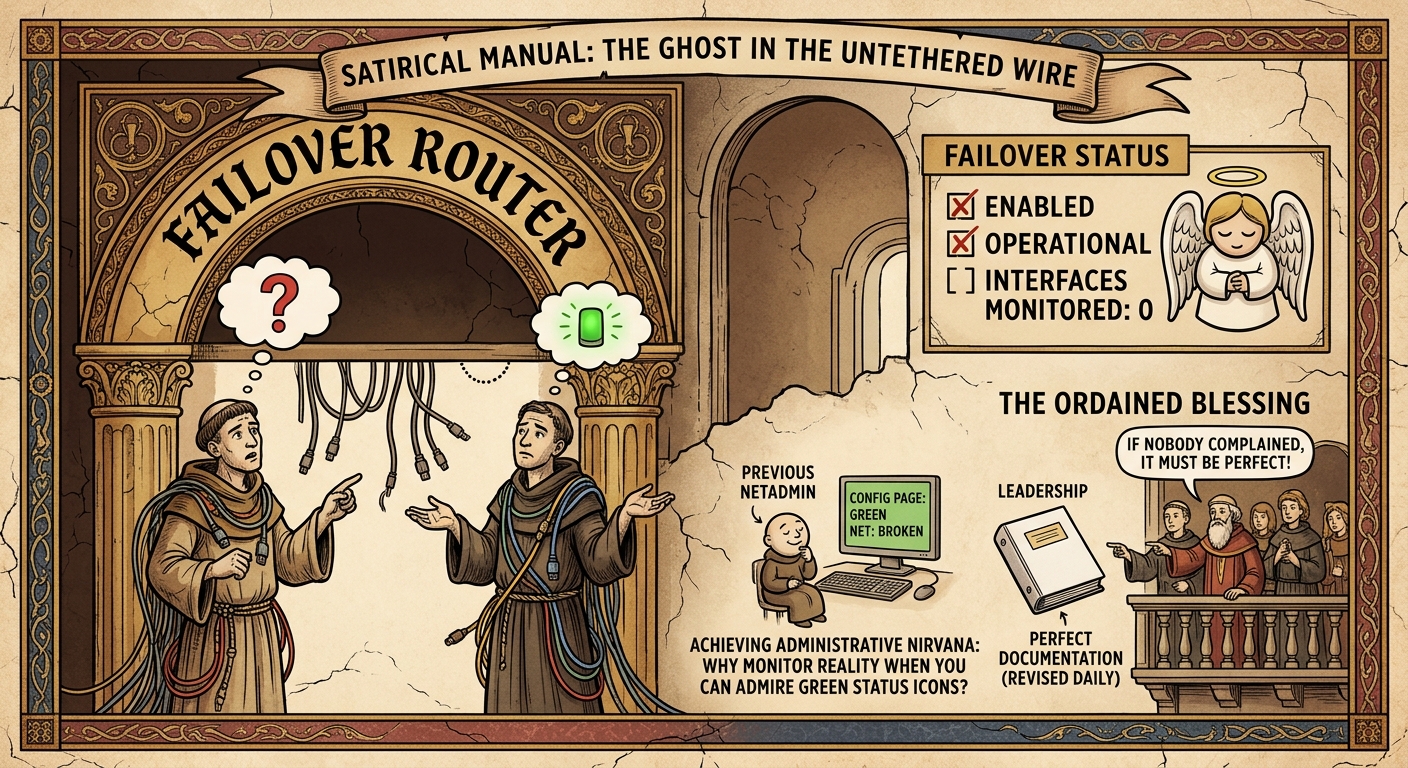
On the ancient legend of the Predecessor, the phantom redundancy, and the sacred art of blind faith.
Introduction
In the higher chambers of The Church, legends are whispered of those who walked before. None loom larger in the lore of the network than the Great Predecessor—a netadmin of such profound detachment that their passing left behind a legacy not of code, but of pure, unadulterated metafiction.
To the common follower, maintenance is a time of nervous testing, where cables are checked, packets are tracked, and systems are verified to ensure they can catch a fall. But to the enlightened leadership and their historical architects, testing is a symptom of doubt. And doubt, as we know, is the enemy of uptime.
The Mirage of the Safety Net
During a recent rite of critical maintenance, the current custodian of the Great Machine knelt before the routing tables to examine the sanctuary of High Availability. There, shining like a beacon of hope in the configuration logs, sat the holy grail: Failover.
The heart of the follower skipped a beat. Relief washed over the chamber. The system was protected! If the primary link severed, a secondary lifeline would instantly engage, catching the digital traffic before it hit the abyss.
It was a masterpiece of architectural illusion.
The Void Beneath the Wire
Closer inspection, however, revealed a deeper theological truth. The failover was indeed configured. It was operational, gleaming with health indicators, and humming with administrative approval.
It just had zero interfaces monitored.
It was a net without a net, a guardian angel standing fast asleep with its eyes sewn shut, waiting for a catastrophe it could neither see nor touch. The backup path was fully armed to catch nothing at all, floating in a serene state of absolute, unmonitored isolation.
The Predecessor’s Philosophy
When the current netadmin stared into the empty chasm of those unmonitored ports, the profound philosophy of the Predecessor became clear.
Why burden a backup link with the messy reality of physical connections? Monitoring implies that something might break, and if something might break, it suggests that the original design was less than divine. By leaving zero interfaces attached, the Predecessor had achieved the ultimate state of administrative nirvana: a failover that could never fail, because it could never actually be reached.
The leadership, when informed of this architectural masterpiece, nodded sagely. They did not care that the safety net was untethered to reality. After all, the configuration page was green, the documentation looked splendid in the binder, and nobody had died yet.
The current follower closed the terminal, whispered a short prayer to the ghost of the Predecessor, and went back to typing into the void.
446 Words
2026-11-11 00:00